HPC.nrw at deRSE26
With contributions on AI and reproducible HPC practices
The deRSE2026 in Stuttgart brought together the IT community around Research Software Engineering, HPC and scientific software development. With posters, community formats and a hands-on workshop, HPC.nrw was actively represented and provided impulses for understandable performance analysis, scalable AI workflows and reproducible HPC practice.
Poster Session
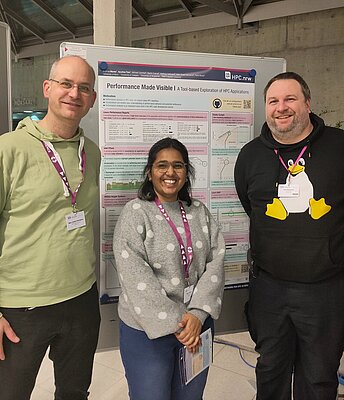
HPC.nrw presented two posters that addressed central topics related to the efficient and reproducible use of high-performance computing systems.
The poster Performance Made Visible by Krishna Sai Lakshmi Gayatri Manda (University of Bonn) demonstrated how visualizations can help make performance analyses on HPC systems more accessible. Many researchers are initially deterred by the complexity of performance optimization — however, numerous tools are already available that make typical application behavior visible and enable an initial high-level screening. The poster presented selected visualizations of such tools and complemented them with brief guidance on interpretation, so that even beginners can more easily identify typical performance issues.
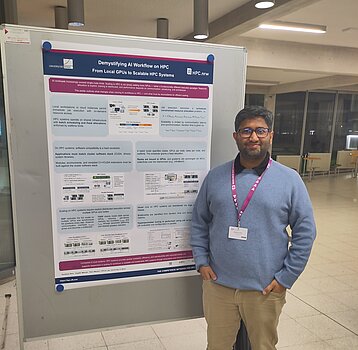
The second poster Demystifying AI Workflow on HPC by Ayushya Pare (University of Bonn) examined the transition from AI workloads running on a single GPU to distributed execution in cluster environments with multiple GPUs. While many applications are initially developed locally, their efficient use on HPC systems requires adapted workflows. The poster highlighted key aspects of this transition — from the software environment and explicit parallelization to the distribution of workloads across multiple nodes.
Reproducible HPC workflows using JUBE
HPC.nrw also contributed to a half-day skill-up on Reproducible HPC workflows using the Jülich Benchmarking Environment (JUBE). The event was organized in cooperation with Thomas Breuer and Dirk Brömmel from the Jülich Supercomputing Centre.
The workshop demonstrated how complex HPC experiments can be efficiently structured, automated, and executed reproducibly using JUBE. In a practical, Carpentry-style hands-on session, participants were able to try out the tools directly.
HPC.nrw’s participation in deRSE2026 once again underscored the importance of exchange between HPC experts, Research Software Engineers, and researchers. Through poster contributions, community formats, and hands-on workshops, HPC.nrw provided valuable impulses for low-threshold access to HPC, the further development of training offerings, and the promotion of reproducible scientific workflows.